

"A house of Dynamit"; Kathryn Bigelow’s ensemble drama, a nuclear attack exposes, a geopolitical-crisis management.
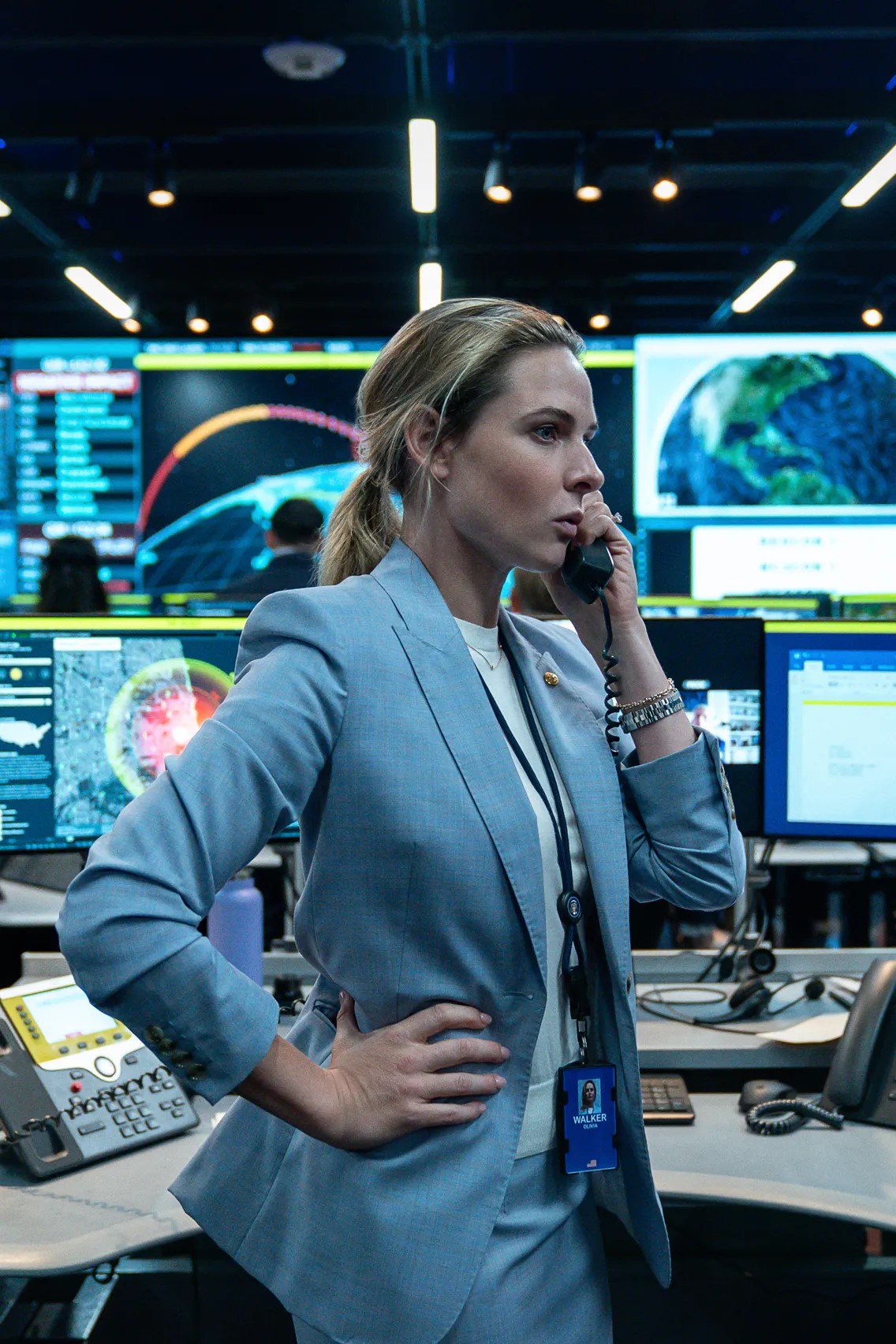



“A house of Dynamite” is the long-awaited new film directed by Kathryn Bigelow, whose last picture was almost a decade ago. That was “Detroit,” which was a fact-based drama; her three prior films, including the highly praised and awarded “The Hurt Locker” and “Zero Dark Thirty,” were historical dramas as well. “Dynamite,” scripted by Noel Oppenheim, is a fiction. It’s also a warning. The tagline for the movie on the posters out here is “Not if but When.”
And the answer to “When".....
"What", did I just say a nuclear war? Yes I did.
Older films about this apocalyptic scenario have considered this eventuality as the result of an accident. Here, in this film, maybe it’s not.
It begins on a seemingly ordinary morning in America, but none of it actually feels ordinary, because the movie takes such pains to emphasize that ordinariness. The script, by Noah Oppenheim (who wrote the script for Pablo Larraín’s bio-pic “Jackie”), filters its anxieties through a strained and mechanical approximation of workplace small talk, in which every attempt at offhandedness feels on the nose. The characters, almost all government employees, are filled in like cells on a spreadsheet; the lucky ones are allotted a box in the “Personal Drama” column. At a missile-defense base in Fort Greely, Alaska, Major Daniel Gonzalez (Anthony Ramos) steps outside for a tense phone call, presumably with his significant other. In Washington, D.C., an unhappy-looking FEMA employee named Cathy Rogers (Moses Ingram) jabbers about her upcoming divorce as she strides toward her office, where she’ll spend an early stretch of her workday checking out Zillow listings. (Spoiler alert: she won’t need them.)
Happier, at least initially, is Captain Olivia Walker (Rebecca Ferguson), who kisses her husband and young son goodbye before heading off to work at the White House. Ferguson gives what is easily the film’s strongest performance, partly because she’s magnetic enough to find an actual character—crisp, efficient, no-nonsense—beneath a mass of quotidianisms. I could watch a ten-minute montage of Walker making her way through White House security, sniping at a slowpoke in the breakfast line, locking away her personal cellphone, and then striding into the Situation Room, where an enormous screen is about to light up with some very bad news.
In short order, Fort Greely picks up on an intercontinental ballistic-missile launch from somewhere in the Pacific—presumably just a test, and one that will splash down in the Sea of Japan. Suddenly, though, the target shifts: “Inclination is flattening,” someone notes, and even viewers who don’t have their parabola calculators handy will guess, from the strain in her voice, what is happening. Before long, the stakes come into terrifying focus: the missile will strike Chicago in less than twenty minutes. Rogers, the FEMA employee, projects that roughly ten million people will be killed, and another ten million will die in the subsequent fallout. Those death tolls, of course, will be just the beginning, depending on how apocalyptic a retaliation campaign the U.S. decides to pursue—a question complicated by the fact that no one knows which country initiated the attack. Satellites failed to detect the initial launch, the first mistake in an escalating chain of errors, including multiple bungled attempts to intercept or destroy the missile, that expose what a crapshoot our system of nuclear defense is.
I was really astonished and chilled and sat with my eyes in the screen to see what will happen! I love Geopilitical films, and films from the cold war, CIA, MI6 and I have surved in the military, so lot's og rules og engagement, so forth. So I was really sticked to my TV, a 5 years OLD OLED 55" philips TV, but nice colours and saund. But then……
Something odd happened, it was like the sory started again, I really had to check where I was in the film, to see, it was about 25%, so I am watching the correct, no issues with my streamimg service, my internet was good condition, but the story started again from the beging, but with a different person perspective!
So I carried on watching the same film 3 times.
The movie is in three parts; at the end of each part, the timeline rewinds to the beginning or thereabouts. The components are varied, including individuals who are experts in their fields and trained to make crucial decisions. But also, we see people with families and banal Beltway lives and everyday concerns. A defense department figure who’s looking after a kid with a fever. A situation room conductor who finds herself staring down her worst day. A specialist on a military base is coming apart after a phone fight with his girlfriend and soon finds himself having to try and knock a missile of possibly North Korean origin out of the sky before it hits Chicago. And more. There’s a Defense Secretary whose beloved daughter actually lives in Chicago. Finally, there’s the President, who doesn’t appear until an hour into the movie, but is often heard in varied windowless amphitheaters plugged into various views of the world, tracking the trajectory of the aforementioned missile.
Can the weapon be knocked out of the air? Whether it can be or not, will the U.S. retaliate? Bigelow takes us not just to the high seats of command, but to the middle-America missile silos that get put on alert. We are at one juncture bounced into a Civil War reenactment, but the movie isn’t time-traveling to make a point: a crucial translator is spending the afternoon there with her son. The movie contains a couple of other not-quite-fake outs, and they’re all pertinent to the theme. As harrowing as the movie is, there’s real pleasure in experiencing how Bigelow orchestrates it all.
Rebecca Ferguson is Olivia Walker, the Situation Room maestro; Tracy Letts is General Baker, who can make a few calls before the matter has to be turned over to the President. Both actors perform profiles in competence and conscience with exceptional craft, all the better to underscore Bigelow and Oppenheim’s point that none of that ultimately matters once Defcon 1 is in play.
Weighing his options, Elba’s chief executive fumes at General Baker, “This is insanity.” Keeping his cool as best he’s able (which is pretty damn good), Baker replies, “This is reality.” Bigelow’s ability to take a series of hypotheticals and render them into narrative actuality has never been more pinpoint accurate or merciless.
My feelings after seeing the film
First impression: "Wow what a great film", actually "A House of Dynamite" is terrifying but is it realistic?
I’ve been watching nuclear war films all my life and it's history, politics, science, and strategy for more than 40 years. None of the many books Ii have read nor many films that I’ve watched on this subject have filled me with such overpowering dread as Kathryn Bigelow’s new movie, A House of Dynamite. It is very realistic, and thus by definition frightful, and watching the news these days is even more terrifying and maybe closer to an atomic war!
Dr. Strangelove, still the genre’s masterpiece and extremely realistic in its detail (Daniel Ellsberg, then a Pentagon staffer, told a colleague after they watched it in a theater, “That was a documentary!”), filtered its dread through caricature and satire. Fail Safe, which came out the same year (1964), was didactic and clinical. There was one hair-raising moment in The Day After (a 1983 TV movie), the scene where a dozen intercontinental ballistic missiles blast out of their silos in eastern Kansas and head toward their targets across the world in the Soviet Union. No one had ever seen a picture like this. I remember thinking, “Holy shit, this is what it will look like.” and in 1983, I was living in the Middle East in Iraq, where the first Gulf war (the Iraq-Iran war) so it hit me hard and i was 17 years old.
I had a similar thought several times while watching A House of Dynamite—this is how it could very well happen, how the people at the top will act, think, and feel
There’s a Reason We Can’t Look Away From ‘A House of Dynamite’
The ticking-clock threat of an imminent missile strike makes for propulsive viewing. It’s long been a go-to setup in Hollywood, from “Dr. Strangelove” on.
Certain premises make for perfect movies, so they keep being repeated. Boy meets girl. Rags to riches. And another that seems remarkably durable: nuclear holocaust has been triggered. We may or may not know why, and we may or may not be able to do anything about it.
This is the setup of Kathryn Bigelow’s latest film, “A House of Dynamite” on Netflix, which springs from the terrifying setup that the relatively peaceful period - at least when it comes to worrying about nukes - that came with the end of the Cold War is now over. A ballistic missile is bound for Chicago. Now what?
“A House of Dynamite” is a deeply researched, almost unbearably taut thriller that eventually mutates into a character study, examining how public servants proceed with their duties when staring the end of the world straight in the eye.
The thriller is part of the grand tradition of Hollywood movies born from nuke anxiety - and, perhaps because the unthinkably high stakes generate a kind of frantic lunacy, they come in several genres, including farce, comedy and panicked drama. Many of them derive tension from a similar question: Should some humans be sacrificed to save more of humanity? Should we strike back pre-emptively or wait to find out what happened? Who can we trust?
And they all work at feature-film length for the same reason: The tick-tick-tick of the missile’s approach provides the perfect plot device; time is literally running out. Here’s a look at the best of them.
1 ‘Dr. Strangelove or: How I Learned to Stop Worrying and Love the Bomb’
Film: https://youtu.be/snTaSJk0n_Y
OK, technically this one doesn’t fit the mold: it’s about people trying to stop the deranged Air Force Brig. Gen. Jack D. Ripper from launching a nuclear attack on the Soviet Union, not the other way around. But no nuke movie list would be complete without Stanley Kubrick’s 1964 bleak-as-hell satirical classic and not just because it gave us classic lines like “Gentlemen! You can’t fight in here! This is the War Room!”
Starring Peter Sellers in four roles, the movie ridicules the doctrine of mutually assured destruction and skewers Cold War attitudes. But its most shrewd and lasting cultural contribution is in mocking how leaders’ insecurities, impotence and monstrous egos - the imagery is explicitly phallic - may be what ends the world.
Released the same year as “Dr. Strangelove,” Sidney Lumet’s “Fail Safe” could not be more tonally different, though it’s drawing on the same deep well of nuclear age anxiety. (It also so closely resembled the novel that “Dr. Strangelove” is based on that Kubrick filed a lawsuit and insisted that his film be released first.) “Fail Safe” stars Henry Fonda as the president who must make an unthinkable decision after a series of human errors leads the U.S. and Soviet Union to the brink of nuclear annihilation. Like “Dr. Strangelove,” its core conflict is between characters who hold fundamentally opposing philosophical views on the wisest course of action.
A message at the end of the film informs us that “it is the stated position of the Department of Defense and the United States Air Force that a rigidly enforced system of safeguards and controls insure that occurrences such as those depicted in this story cannot happen” - but it does little to dispel the chill that’s wrapped itself around your spine.
2 ‘WarGames’
Oops! In John Badham’s “WarGames” (1983), a high school hacker (played by Matthew Broderick) nearly annihilates humanity when he unwittingly hacks into a military supercomputer and accidentally triggers a false alarm of global thermonuclear war, thinking he’s playing a game. A thriller and a comedy, it was one of the first depictions of remote computing in pop culture. And the mishap once again brings serious ideas about the wisest course of action into conflict with one another.
When President Ronald Reagan saw the movie, it captured his imagination: He talked about it with his advisers, the Joint Chiefs of Staff and members of Congress, asking if the premise was possible. The answer: technically, yes. Fifteen months later, he signed the first classified national security decision directive., Who says movies are just entertainment?
Film: https://youtu.be/YIh41wZEd5c
3 ‘The Day After’
film: https://youtu.be/7VG2aJyIFrA
As the name suggests, much of “The Day After” (1983) focuses on the aftermath of a nuclear detonation, something verging on dystopian horror. But for the first stretch, we’re bracing for impact, as Americans learn of the invasion and, ultimately, incoming missiles. The movie ran on ABC on Nov. 20, 1983 and was watched by nearly 100 million people — about 67 percent of the American viewing public that night.
This film, too, had a direct effect on public policy: It’s credited with softening Reagan’s stance on nuclear policy, and in his memoirs, he wrote that the movie influenced his decision to sign the 1987 Intermediate-Range Nuclear Forces Treaty, which required the United States and Soviet Union to reduce their nuclear arsenals. For many audiences, meanwhile, the experience of watching the film proved unforgettable.
4 ‘Miracle Mile’ (1988)
Film: https://youtu.be/7fscf9m1Lfw
There’s space for romance, however bleak, in a world about to end. Steve De Jarnatt’s “Miracle Mile” (1988) stars Anthony Edwards and Mare Winningham as Harry and Julie, perhaps the last star-crossed lovers. They meet by chance and fall instantly in love, and arrange to see each other later that night — but alas, Harry’s alarm doesn’t go off, and when he tries to call Julie, he hears someone else on the line, warning that nuclear war will break out in 70 minutes.
“Miracle Mile” happens farther away from the halls of power than many nuke movies; it’s named for the Los Angeles neighborhood where most of the events take place. It mostly depicts ordinary people reacting to the news that the world is ending, and without a lot of optimism about human nature, either. This story can only end in tragedy: a love affair of the most epic proportions that takes place in barely more than an hour. But that’s also kind of the perfect setup for a grand passion.
5 ‘Crimson Tide’
Film: https://youtu.be/NTH4VFxRs9E
The nuclear film that might most closely resemble “A House of Dynamite,” at least in tone, is “Crimson Tide,” Tony Scott’s 1995 submarine action thriller starring Denzel Washington and Gene Hackman. The story — which loosely parallels real events during the Cuban missile crisis — pits the strong-willed veteran captain of a Navy submarine against his more rational but less-experienced second in command. They’re tasked with launching a pre-emptive nuclear strike against a Russian ultranationalist rebel if he fuels his missiles.
“Crimson Tide” is fast-paced and exciting, and because it’s largely confined to a submarine, it’s often claustrophobically tense. Questions of ethics and morals, intuition and logic, right and wrong are all at stake, and decisions made on a dime can have huge consequences. The results, you might say, can be pretty explosive.
That's it folks :-)
